Echoes of the Earth: Cultural Education for the Environment in the Visayas
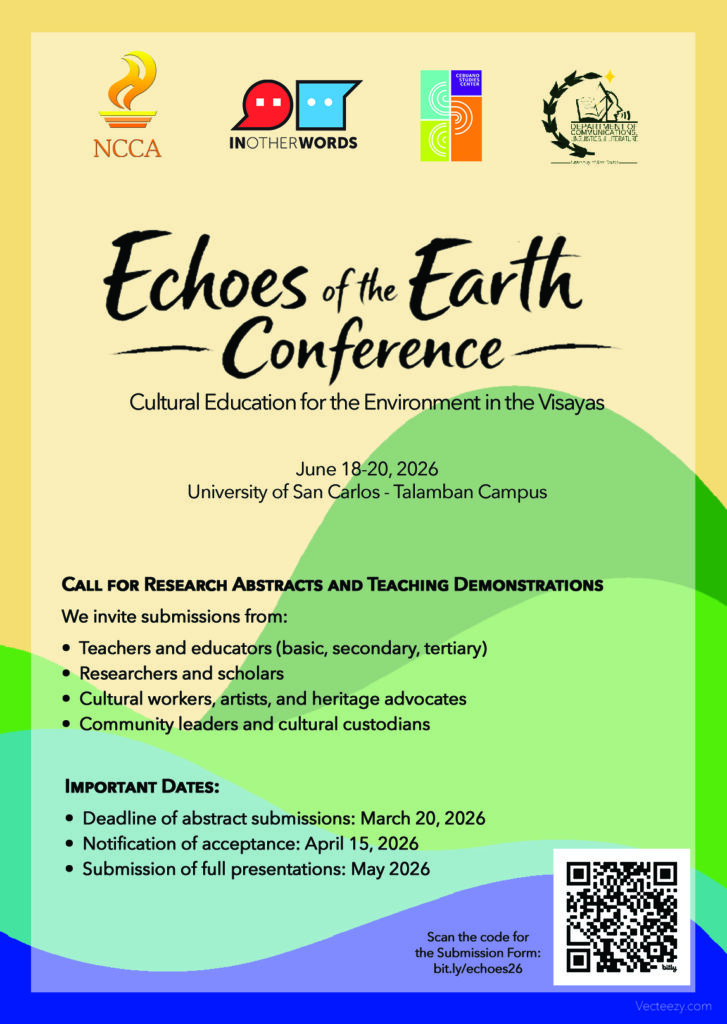
Echoes of the Earth: Cultural Education for the Environment in the Visayas
June 18–20, 2026
University of San Carlos – Talamban Campus, Cebu City
Across the Visayas, communities have long carried ways of knowing the land, the sea, the seasons, and the spirits that dwell within them. These knowledges, spoken in Cebuano, Hiligaynon, Waray, and other local languages, continue to guide how people farm, fish, teach, heal, and imagine the future. Yet many of these wisdom traditions remain underrepresented in formal education and scholarly discourse.
Echoes of the Earth invites educators, researchers, cultural workers, and community knowledge holders to gather and ask: How can cultural education rooted in local lifeworlds respond to today’s environmental crises? How can Visayan classrooms become spaces where ancestral wisdom and contemporary pedagogy meet?
This conference seeks to create a vibrant, multilingual, and practice-oriented space where local knowledges are not only studied but actively taught, demonstrated, and shared.
Conference Objectives
The conference aims to bring together teachers, scholars, cultural workers, and community leaders to respond collectively to the intertwined challenges of cultural renewal and environmental stewardship by:
- Reclaiming Cultural Roots
Highlighting indigenous and local ecological knowledge, environmental ethics, and place-based cultural practices in the Visayas. - Reconnecting Culture, Community, and Nature
Exploring how teaching and learning can restore meaningful relationships between people, place, and environment. - Innovating Pedagogy
Showcasing research-based, culturally grounded teaching strategies through live or documented teaching demonstrations. - Building Multilingual Knowledge Resources
Encouraging the production of publishable and classroom-ready materials in Cebuano, Hiligaynon, Waray, Filipino, and English. - Strengthening Regional Networks
Fostering collaborations among schools, universities, cultural institutions, and community organizations across the Visayas.
Call for Research Abstracts and Teaching Demonstrations
We invite submissions from:
- Teachers and teacher-educators (basic, secondary, tertiary)
- Researchers and scholars
- Cultural workers, artists, and heritage advocates
- Community leaders and cultural custodians
We especially encourage contributions that:
- Are grounded in local communities or regional contexts
- Engage indigenous or folk knowledge systems
- Use or reflect on mother-tongue or multilingual education
- Bridge academic research and classroom practice
Important Dates
- Deadline for Abstract Submission: March 20, 2026
- Notification of Acceptance: April 15, 2026
- Submission of Full Presentations / Teaching Materials: May 2026
Submission Guidelines
- Abstract Length: 250 words
- Abstract File Format for upload: DOC, DOCX, or PDF
- Further details are available at the Abstract Submission Form
- Submission Form link: bit.ly/echoes26
Scan to proceed to the Abstract Submission Form:

CONFERENCE TRACKS
Track 1: Yuta, Duta, Kalikupan — Local Ecologies and Ways of Knowing
This track foregrounds how Visayan communities understand the environment as lived space rather than abstract concept. Papers and demonstrations may explore land, sea, rivers, forests, and weather as sites of memory, labor, belief, and responsibility, using Cebuano, Hiligaynon, or Waray frameworks.
Sample focuses: yutang kabilin, duta kag tubig, kalikupan, island ecologies, coastal and upland lifeworlds
Track 2: Panagtag-iya, Pagtililipon, Panabang — Collective Care and Environmental Ethics
This track centers Visayan values of shared responsibility, cooperation, and mutual aid as foundations for environmental education. Contributions may examine community-based stewardship, indigenous governance practices, and collective responses to ecological crises.
Sample focuses: communal land/sea care, bantay-dagat, panabang after disasters, ethics of shared survival
Track 3: Kabuhi ug Kinabuhi — Environment, Labor, and Everyday Life
This track invites reflections on how ecological knowledge is embedded in daily work and survival – farming, fishing, weaving, healing, and household practices. Submissions may show how these lived experiences can be translated into meaningful educational content.
Sample focuses: rice and fishing cultures, seasonal labor, livelihood-based pedagogy, work as ecological knowledge
Track 4: Panumduman sang Lugar — Memory, History, and Environmental Narratives
This track explores how stories, oral histories, epics, songs, and disaster memories shape environmental consciousness in the Visayas. Contributions may analyze texts or demonstrate how narrative can be used as a teaching tool for environmental awareness.
Sample focuses: Hinilawod, local legends, flood and storm narratives, place-based storytelling
Track 5: Kusog, Gahum, Himakas — Power, Crisis, and Resilience
This track examines how Visayan communities interpret power—of nature, people, and systems—especially in contexts of environmental crisis. Papers may address climate change, disasters, displacement, and survival, while teaching demonstrations may focus on resilience education.
Sample focuses: bagyo as teacher, gahum sa kinaiyahan, himakas, adaptation and endurance
Track 6: Pulong bilang Dalan — Language, Translation, and Environmental Education
This track highlights the role of language in shaping ecological understanding. Submissions may explore mother-tongue instruction, translation of environmental concepts, and the creation of multilingual teaching materials rooted in local contexts.
Sample focuses: Cebuano/Hiligaynon/Waray pedagogy, MTB-MLE, translating ecological terms, classroom language practices
Track 7: Sa Klase ug sa Komunidad — Teaching Demonstrations and Pedagogical Practices
This practice-oriented track is dedicated to teaching demonstrations and classroom-ready strategies. Contributors are encouraged to present lesson plans, activities, modules, or community workshops that integrate culture and environmental education.
Sample focuses: lesson demonstrations, community-based learning, culture-centered teaching strategies
Track 8: Gikan sa Kabilin ngadto sa Kaugmaon — Heritage, Policy, and Future Pathways
This track looks forward, examining how local knowledge can inform curriculum development, cultural policy, sustainability initiatives, and institutional partnerships. Submissions may bridge grassroots practice with formal education and governance.
Sample focuses: curriculum design, CHED/DepEd alignment, cultural sustainability, regional collaboration
Why Submit?
Every day, teachers and community educators across the Visayas are already teaching the environment – through stories told in class, lessons shaped by local landscapes, and values passed on in the mother tongue. Echoes of the Earth invites you to share these practices and make them visible.
This conference is for:
- Teachers who integrate local stories, languages, and practices into their lessons
- Educators who turn rice fields, rivers, seas, and neighborhoods into classrooms
- Community educators who teach through tradition, work, and lived experience
We welcome:
- Classroom lessons that work
- Teaching strategies grounded in local culture
- Community-based learning practices worth sharing
- Simple but powerful ideas that connect learners to place and environment
By submitting, you will:
- Share your work with educators from Central Visayas, Western Visayas, and Eastern Visayas
- Help build teaching materials rooted in our own languages and cultures
- Contribute to a growing network of teachers committed to environmental care
- Gain recognition for your work as a knowledge holder and cultural educator
Your voice belongs here. Let your classroom practices, community lessons, and local wisdom echo beyond your own school or barangay.
Submit. Share. Teach from where you stand.
Category: Events